
 |
Southern Florida and the BahamasJanuary, 2008
Rainbow over Lake Worth, FL Two days before we left Riviera Beach, we witnessed a near drug bust at the dock. A huge catamaran pulled in followed by Coast Guard and Police and Border Patrol boats. The captain of the cat was immediately hand-cuffed while a German Shepherd was brought on board to sniff out the contraband. The search seemed to go on forever. When Kenny and I came back from an evening in West Palm Beach, the guy was nowhere to be seen but his female first mate was still kicking around. The next day the guy was back and they took off in their boat. Apparently nothing was found. West Palm was a bit overwhelming. There’s a popular quarter called City Place with lots of shops and restaurants. It has the ambiance of a shopping mall only it’s outside. All the restaurants were so loud that we had to escape and find a quiet out of the way place. We landed in a place called Oysters. Not cheap, but good and we could hear each other. 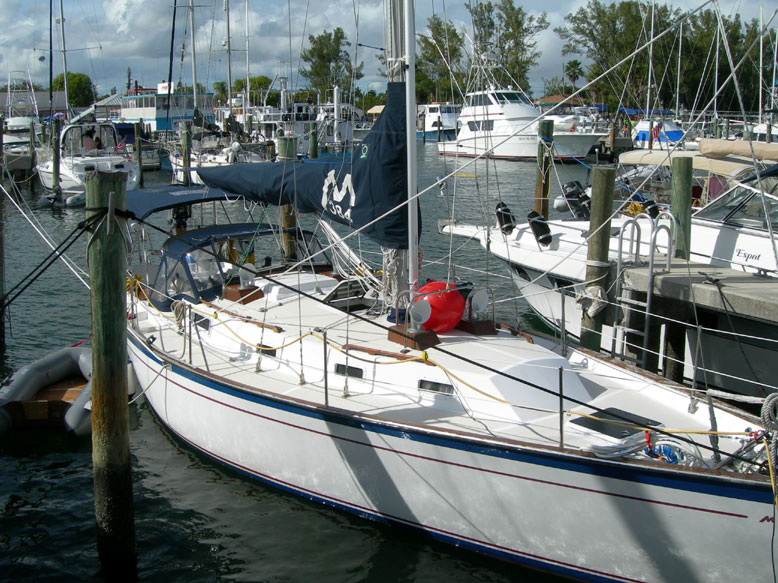
Our slip at the Riviera Beach City Marina On January 7, we left the cozy marina at Riviera Beach and headed for Fort Lauderdale. We weren’t prepared for the weather that day. It felt like we stepped into a washing machine. The waves were choppy and going every which way, but mostly hitting us on the port side with great whacks. Both of us felt ill for the first couple of hours but we got used to it. Then a squall came along and it rained on us for about 20 minutes. It was a relief when we approached Fort Lauderdale and a group of very friendly dolphins accompanied us to the harbor entrance. We snagged a mooring ball at Las Olas marina and settled in for the evening. 
Ft. Lauderdale The next day we went for a long walk along the beach and ogled all the peeps of various shapes and sizes in their bathing costumes. A five hundred pound man wearing only peddle pushers sprawled on the boardwalk like a giant manatee out of water. Many of the tourist traps along the water were touting two giant margaritas for the price of one. We couldn’t resist. We plopped down, tired from walking and dove into our fishbowl sized drinks with chips and salsa and guacamole. The bill was $30 including tip, so it didn’t turn out to be the great deal advertised. Ya gotta splurge from time to time. 
Margarittaville We spoke via cell phone to our friends, Greg and Corinne on Gormã their Morgan 38. They were in Miami and then headed for No Name Harbor in Key Biscayne in two days. We decided to sail directly for Key Biscayne the next day and wait for them. Entering Government Cut at Miami, the loudest, fastest, ugliest motorboats in existence zoomed past us. We got through their as quickly as possible. On the way to No Name Harbor (yes, that’s it’s name) we stopped at a marina to pump out our holding tank, which is always a fun job. To put it delicately, the holding tank is where the contents of the toilet reside. Putting on our surgical gloves, we placed the suction tube over the hole and pumped away ‘til our tank was clear. That marina didn’t have diesel fuel, so we stopped again to top off the tanks. Best to have them full before crossing the Gulf Stream. No Name Harbor, at Key Biscayne was full of boats. We dropped our anchor anyway, though we were close enough to other vessels to hear their conversations. Fortunately there was no wind or current to speak of, so we didn’t need to worry about dragging anchor or swinging into other boats. Gormã was to arrive the following day and we were anxious to see out old buddies and hear their tales. The next day arrived, but Greg and Corinne on Gormã did not. They called to say they had some kind of problem with their engine and would be staying up in Miami until they could diagnose the problem and have it repaired. They suggested we look for a boat called Two Pelicans that was anchored in No Name Harbor. The crew consisted of an older man and younger one who were heading for the Bahamas. The older man had apparently done it before and was quite knowledgeable. 
Rowing around No Name Harbor After searching all around the Harbor in our dinghy we realized they were the boat directly behind us. We hadn’t realized it was them, because the name of their boat was obscured by the other which had rafted up to them. I went to have a chat with the crew of both boats. The captain of Canadian flagged Two Pelicans was a former British submariner named Jeremy and his mate was a 23-year-old novice from Seattle that Jeremy found on the internet through Find a Crew. Their buddy boat was a 37-foot Irwin ketch called Miss Maddy. The crew was a delightful young couple (ages 32 and 28) from New Jersey named David and Kristin. The average age of the cruising population seems to be about 65, so it was fun to find some youngsters. David was a very mechanically inclined guy who, though relatively new to sailing seemed to have a real feel for the workings of the boat. They said they were indeed headed for the Bahamas and that they’d be leaving sometime after midnight. Doing this they would arrive at Bimini at day break and if the weather was good, rather than stop, they’d continue sailing across the Great Bahamas Bank toward the more distant Berry Islands and anchor after nightfall somewhere on the banks. We told them we were more of a mind to leave very early in the morning before sunrise and cross the Gulf Stream in daylight. We could still bypass Bimini and anchor on the banks, weather permitting. Then we got a surprise. Gormã called to say they would be joining us that evening after all. They’re problem turned out to be nothing more than a pesky palm leaf wrapped around their propeller. 
Rafting up with Gormã in No Name Harbor When Gormã arrived in No Name Harbor, there was precious little anchoring space, so they rafted up to us. After settling in, they came over for a nightcap and we shared our tales of the past two months traveling down the ICW. Before we came up with a final decision concerning our crossing to the Bahamas, I overheard a bunch of other sailboats talking on the VHF radio about the very same subject. They were pushing their departure date back one day when the winds would be more favorable and the waves smaller. It sounded like a reasonable argument so I called Admiral Jeremy on Two Pelicans to suggest we do as the other boats suggested. He agreed. We would remain in No Name Harbor for one more day and then depart for the Bahamas. As we had an extra day in No Name Harbor, Kenny decided to replace the sacrificial zinc on the propeller shaft. Our zinc had disintegrated to a fourth of its original size and needed replacing. Kenny got out his snorkel gear and went below to remove the old zinc. While at work under the boat a large, swimming iguana started heading directly for Mary T. Kenny surfaced with the old, crumbling zinc in hand and stood on the ladder on the stern. The iguana was making a B-line for Kenny. He climbed further up the ladder as the scary looking reptile approached. The iguana came right up to our hull, cocked its head to one side and looked right up at us. It was clearly looking for a handout, but we weren’t putting out. Kenny needed to put the new zinc on, but he wasn’t about to get back in the water with that creepy, begging iguana swimming around our boat. After about 20 minutes, it disappeared and the brave captain slid back into the water to complete his job. We all got underway at 4:30 a.m. on Saturday, January 12. Bahamas bound at last! Mary T led the flotilla of four boats out of the anchorage through the dark channel toward the Atlantic Ocean. I was at the helm while Kenny manned the spotlight and binoculars. Not all of the channel markers were flashing lights, so Kenny picked them out with the high beam light so we could see them and stay inside the channel. Outside the channel was very shallow and there were houses on built on stilts. How embarrassing it would be to go crashing through a stranger’s living room before dawn. Around 6:00 a.m. we were greeted by the bucking Atlantic Ocean. It was a relief to be in deep open water even if it was a bit rough. What we didn’t realize until hours later was that we had failed to lock down our forward hatch, which is just above the V-berth where we sleep. It was soaked with salt water as were most of my unmentionables, which I store in a net hanging in the V-berth. Apart from that all was going well. The rising sun is always a joy to see at sea. The waves were two to four feet and the wind was from the southeast around 12-15 knots. We alternated between sailing and motor sailing to make better time. We couldn’t maintain the course necessary without motoring from time to time, because the wind and Gulf Stream kept pushing us further north. Before long our fearless leader, Admiral Jeremy on Two Pelicans was completely out of sight and unreachable on the radio. We maintained regular VHF radio contact with the other two boats. There were at least 30 sailboats crossing over to the Bahamas that day as the weather was quite ideal. One vessel, called Sun Dancer, started up an informal network on the VHF for all Bahamas bound vessels. I joined the network, which meant every hour we had to tune to channel five and report our position and destination. None of the other boats in our group joined the network at first, but Gormã joined later. I learned by listening to the other boats that almost everyone was heading to Chub Key or Nassau en route to the Exumas. We too, were ultimately headed for the Exumas in the southeast Bahamas, though we didn’t see any need to rush. 
A beach on Great Harbour Cay When we finally hit the Great Bahamas Bank our eyes nearly popped out of our heads. The color of the water was like a swimming pool and you could see the bottom. I’d never sailed into anything so beautiful. The waves were much calmer on the banks too. Our plan was to continue for a few more hours and then anchor when we were within a day’s sail of Great Harbour Cay in the northern Berry Islands. But none of the other boats had this plan and we were beginning to wonder why. I struck up a conversation with the crew of Sun Dancer, the radio network organizers. They said that Great Harbour Cay was a bit off the beaten path for those heading to the Exumas. Some of the other boats were making for the Mackie shoal to anchor (slightly south of our intended anchorage) and then heading for Chub Cay, southern most of the Berrys, in the morning. The others were sailing overnight all the way to Nassau. 
Another view of the beach at Great Harbour Cay We liked the idea of sailing all the way to Nassau but it meant staying up all night and we were tired. I checked in with Gormã and Miss Maddy to see what they wanted to do. Everyone was feeling a little tired and we could no longer remember why we’d decided to go to Great Harbour Cay instead of Chub Cay, which was more on the way to the Exumas. Unfortunately we still couldn’t reach Two Pelicans to ask the Admiral, who was the primary architect of our chosen route. The fact that he’d gotten so far ahead was starting to rankle a bit. I asked Sun Dancer if she or any of the Bahamas bound boats could raise Two Pelicans on the radio. Within minutes, Sun Dancer picked up Two
Pelicans on the VHF so she
acted as a relay between Mary T and them. Though we could not hear each
other, Sun Dancer could hear and talk to both of us. I had her ask the
Admiral what he thought about going all the way to Nassau. He said it
meant going off the Banks into the tongue of the ocean and it could be
rough. Okay then, Mary T would stick with plan “A.” Miss Maddy and Gormã followed suit. Two Pelicans wanted to go nearly all the way to Great Harbour Cay before anchoring, but the rest of us wanted to stop sooner. We were all feeling the effects of having gotten up before 4:00 a.m.. We enjoyed some glorious sailing on the Banks with our motors off, before the wind dropped of and darkness fell upon us. In order to put more miles behind us, we all started motor sailing. Kenny came up for his watch and I went below to rest. Before I knew it, Kenny was waking me up, so I could take the helm while he lowered the main sail. We were getting ready to anchor. Much to my surprise, during my sleep, we had caught up to Two Pelicans. He suggested we anchor a good distance from the little fishing boats that were long-lining nearby. Their boats were so tiny, they didn’t even make a blip on the radar, but I could see their dim lights floating in the darkness up ahead. As we were preparing to anchor, Gormã suddenly announced that they had other plans and would be heading for the Mackie shoal to anchor with the other boats. For two months we’d been trying to catch up with them and in 48 hours they were out of sight again. What caused their abrupt change of plans, we could only guess. Was it the fishermen? Was it the fact that all the other boats had chosen another path? Our flotilla was down to three boats. The anchorage on the Banks was one of the loveliest ever. We lay in the cockpit of Mary T with our glasses of wine and gazed up at the endless skyscape of brilliant stars. 
Amy at the beach Up at dawn, we weighed anchor and headed straight for Great Harbour Cay. The wind was steady around 13 knots out of the southeast. We cut off the motor as soon as we raised sail and averaged 5.5 knots all day across the beautiful turquoise banks. It was the best day of sailing we’d ever had in our whole lives. We felt like we were in an advertisement for tourism in the Bahamas. In the late afternoon, we arrived in Great Harbour Cay, population 650. After clearing customs, the group came together aboard Mary T to share a bottle of champagne courtesy of Dave and Kristin, the crew on Miss Maddy. After enjoying the marina showers, we all headed up to the restaurant at the marina for a celebratory meal. Upon seeing the prices posted on the wall, we all did an about face and returned to our separate boats to dine. The average price for entrees was $38. It was full of wealthy ex-pats. It seemed strange at a low-priced marina with crumbling docks. The total population of the chain is 700 and nearly all of them live on Great Harbour Cay. 
Captain Dave of Miss Maddy Day number two on Great Harbour Cay, the crew of Miss Maddy and Kenny and I took our bikes to explore the island. Admiral Jeremy and young Alex were bikeless. We found a reasonably priced restaurant/bar where all the local men hang out playing pool and backgammon. The four of us sat at the bar shouting to each other over the boisterous patrons. No matter, we were enjoying being part of the local scene. It didn’t take us long to learn that the two major activities on the Cay were drinking and fishing. 
Great Harbour Cay The next day, Miss Maddy decided to head for an anchorage further south in the Berrys and continue onto Nassau the following day. The rest of us decided to stay put, hoping for calmer weather. The flotilla was shrinking further. Kenny and I rode to the beach, took a swim in the crystal clear waters, and walked forever along the white sand. After meeting the Admiral for lunch at another local joint, we visited a liquor store to check out the prices of rum. People were drinking inside the store as if it were a bar. Instead of sitting on chairs at tables, noisy conversational pods formed around cases of beer and liquor. A large sign over the fridge proclaimed NO DRINKING IN THE STORE. Seeing Kenny and I struggling to talk to each other over the din, the cashier gave the shushing signal to the most boisterous group. They quieted down for all of 15 seconds and then the volume was back up. One day a 27-foot sailboat joined us at the marina in Great Harbour Cay. The crew of two, Eric and Gerald, were very friendly. That evening they came aboard Mary T for a beer and talk about weather. They realized they had to head back to Florida very early the following day. Eric had amazing stories about spear fishing and being chased by sharks in pursuit of his catch. They had a lot of fresh fish to consume, so they invited us all over to their boat for dinner. Turned out Eric owns a restaurant and is a top-notch chef. He fed us the hog fish he’d speared that day along with pumpkin, cabbage salad, and an undercooked roasted potato medley provided by yours truly. I must start catching some fish. I have a hand-line all ready to go, but I haven’t even put it in the water yet. 
Leaving GHC with Two Pelicans following It is now January 17, 2008 and we’ve been on Great Harbour Cay for five days. It is not unpleasant, but we’re beginning to feel like we should’ve headed straight for Nassau with all those other sailboats rather than coming here. Cruisers we’ve met along the way had told us it’s easy to get stuck in certain places waiting for favorable weather conditions and now we’re witnessing this phenomenon first hand. We always promise ourselves we’ll never say woulda, shoulda, coulda, because whatever we did, it was for a good reason at the time. Still, as we think about all the other sailors with whom we crossed the Gulf Stream, who are already in Nassau or better yet, enjoying the Island chain known as the Exumas, we can’t help but feel a tinge of regret. The Exumas is where we’re headed. We are enjoying the biking and beach here and congratulate ourselves for being in a place off the beaten path with few cruisers, but we wonder when we’ll be able to move on. Our plan was to take off tomorrow for an anchorage between Hoffman and Devil’s Cay further south in the Berry Islands chain. The following day would be a 40 mile run to Nassau. Nassau is just 30 miles from our first destination in the Exumas. But the wind is blowing hard out of the southeast, which is exactly the direction we need to go. The waves are over seven feet, so it would mean motoring into an angry ocean for hours. On Sunday, the wind will clock to the west briefly and then settle into a 30 knot nor’easter. That may be the day to go to Nassau, as we’d have the wind at our back, but it’s a hell of a breeze. So we sit here day after day, listening to the weather wondering when we’ll leave and trying to tell ourselves it doesn’t matter, because we’re in a perfectly lovely spot. It is a perfect allegory for the psychological and spiritual dilemmas of life. We are always trying to move forward, progress, grow and in all our striving we fail to fully appreciate the present moment. On January 18 we awoke to a relatively calm day. Our immediate thought: “Let’s go now, before it changes. We consulted with Jeremy and came up with a plan. We’d head for Andros to the southwest. Most of the trip would be an easy motor sail until we hit the Tongue of the ocean, where things could get a little rough, but Jeremy said we’d only be in the tongue for about 12 nautical miles. Racing like mad to get things ready, we paid for our slip at the marina and took off at 9:15 a.m.. It was Pirate Friday, so Kenny and I put on our costumes and sang the pirate song.
It was a warm sunny day and all was going well, though I soon realized it was a longer trip than we’d thought. It was 21 nautical miles from the northwest light to Andros, not 12 as Jeremy had estimated earlier. That meant our total trip was close to 50 nautical miles. Unless we could maintain a speed of nearly seven knots, we would not make our anchorage before dark. As soon as we hit the tongue of the ocean and headed directly toward Andros, our speed slowed to 4 knots. The wind was right on our nose, so we could no longer sail and the four to five-foot waves were slowing us even more. It was clear we would arrive in darkness and Two Pelicans was far behind us. I called Jeremy on the VHF and told him we’d decided to head for the closer Chub Cay. “There’s no good anchorage there and the marina’s very expensive,” replied the Admiral. “We don’t care. We’ll pay.” The Admiral said he’d think about it and get back to us. As soon as we changed course for Chub Cay, (12 nautical miles from our position) we picked up 2.5 knots. It was a wet and salty ride and we cruised into the marina just before dark. Two Pelicans called to say they’d decided to continue through the night to Nassau. The flotilla had dissolved. Mary T is on her own again. 
Amy at the Chub Cay Pool Bar It was a relief to tie up to a nice beefy cement floating dock. The marina at Chub Cay Club is indeed top notch and very expensive. Mary T is the smallest, cheapest boat in the whole joint when we arrived. We figured we could splurge for one night. The next day we’d take off early for Nassau…. or so we thought…. Three days later, and we’re still living in champagne surroundings on our beer budget. This marina/resort owns most of the island, so unless you’re a guest here, you’re not welcome. The Bahamian employees live in a compound slightly removed from the marina and resort lodgings. When they’re not working, they stay in their compound, so there’s not a lot of mixing. Most of the marina clients are sport fishers or mega yachts. In fact we arrived in the middle of a marlin fishing competition. The other clients are poor sods like us who get stuck here because of the weather. 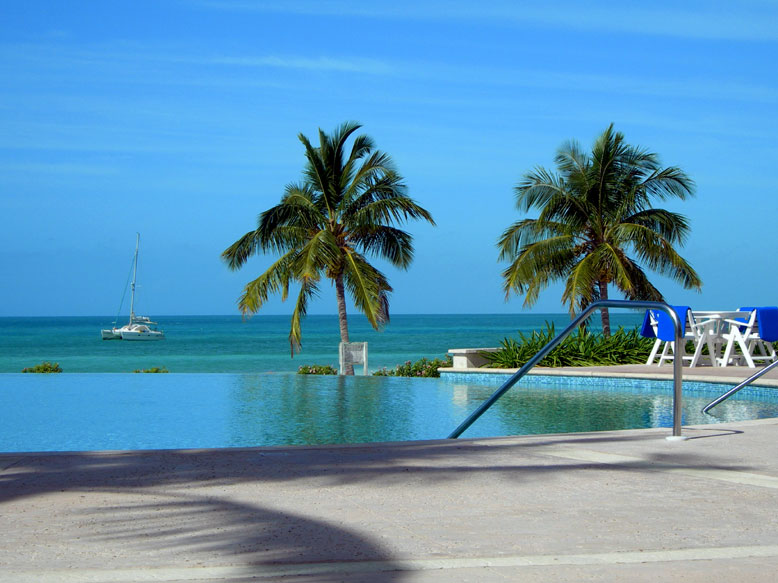
View from the pool Sea of Tranquility, in the slip next to us, is just such a case. Lonnie and Phyllis joined us last night on Mary T for a cocktail. Lonnie brought his I-pod and plugged it in immediately so we could enjoy his new toy. Jimmy Buffet was the first musician in the line up. After they left, we watched an ancient Alfred Hitchcock movie on DVD. I fell asleep 1/3 of the way through the flick. As we’re stuck here on account of the weather, we decided to just relax and enjoy our misfortune in the lap of luxury. The marina boasts an infinity pool just off the beach with a bar built into it so you can swim up to it for your favorite rum beverage. (www.chbucay.com) That’s exactly what we did our second day here. Yesterday a front came through and it was too cloudy, cool and windy for swimming so we took a walk instead. Today it’s been raining on and off all day, so we stayed in bed late and Kenny cooked a pancake brunch. We’re hoping to go to Nassau tomorrow or at the very latest the day after tomorrow. Our friends, the Keatings, are coming to meet us in George Town at the southern end of the Exumas and we certainly would like to be there to meet them. We had no idea there would be so many fronts coming through. They seem to follow on each other’s heels. Oh well. Live and learn. It’s all good. January 22, 2008We’re still hanging out at Chub Cay Club at Harry’s Bar where we come to get on-line. The wireless network doesn’t seem to reach out to our boat slip. For the amount of money one pays to stay at this joint, one would expect a little bit better services. The showers are a million miles away from the dock and you have to walk through a construction site to get there. The woman’s shower has no curtains on the windows, no lock on the door and no door on the shower. Only the hot water works so you have to work fast before it reaches the boiling point. The pump out at the marina doesn’t work, so we can’t empty our holding tank. The dock master says it’s missing a part, but I have a feeling they just don’t feel like doing it. Anyway, we’re outta this little paradise tomorrow. Nassau here we come. 
Nassau, New Providence Island The trip to Nassau was uneventful. With the wind on our nose, we motored the whole way through moderate swells. Upon our arrival at Harbour Central Marina, we immediately spotted Two Pelicans. The Admiral was still there. He recounted his harrowing tale. After a rough sail through the night, he arrived at the mouth of Nassau Harbour at 4 a.m., whereupon he hove-to until daybreak. He had to continue waiting for two enormous cruise ships to enter the harbor before he could go in sometime after 9 a.m. Rather than go to the marina, where I’d made reservations for our two boats, he decided to anchor in the harbor along with some other cruisers. Relieved to be settled, he and his shipmate, Alex, took their dinghy to shore and dined at the Green Parrot. No sooner had they started to unwind when a large dark cloud appeared on the horizon. They made for the dinghy, but before they reached Two Pelicans, they found themselves in the middle of a blinding squall. 
Nassau, New Providence Island The high winds and rain kept up for nearly 48 hours straight. Jeremy and Alex spent most of that time struggling to keep their boat from dragging into other anchored vessels. Each time they set the anchor, it would drag and they’d have to pull it up and reset it. Finally it took hold, but Jeremy was still not able to sleep. When finally the sun came out again, they decided to weigh anchor and check into the marina. The anchor wouldn’t budge. As they pulled up on the anchor chain, the bow of the boat started to point down. Finally, young Alex dove down 25 feet with nothing but a mask on and unwound the chain, which was wrapped several times around a large pipe “with antlers.” After all the headaches Alex seemed to cause Jeremy, he finally saved the day. 
The crews of Gormã and Miss Maddy along with Amy We then learned from Jeremy, that Gormã was also in Nassau. They’d been held up by transmission problems and Corinne had broken her wrist. As they were attempting to leave Nassau, the transmission got stuck in reverse and they went careening into another boat in the marina. Corinne tried to fend off the boat and broke her wrist in the process. Before we knew it, Miss Maddy appeared in Nassau as well. They’d made it into the Exumas, but came back to Nassau because Dave’s sister was flying in for a visit. They’d had no mishaps in their travels, but some very lively sailing, heeled over so far their jib was dragging through the waves. Nassau is a necessary evil in the cruiser’s itinerary. It’s on the way to everywhere and a handy place to re-provision, but it’s not a particularly desirable destination. It has a few grand old buildings, including the parliament and a nice park, but most of what we see from the waterfront is unremarkable and dirty. Streams of tourists pour off of the cruise ships at one end of town with liquor stores and designer name boutiques strategically placed for their shopping pleasure. We wandered down there because we heard there were good deals on Bacardi rum. Indeed, we picked up two bottles for $15. We also bought 3 t-shirts for $10 from Perry on the sidewalk. Later we found another liquor store that sold bottles of local rum for even less and offered a 20% discount for purchasing six bottles. So we got six more bottles of booze, six bottles of wine and a case of beer. I’ve never purchased so much alcohol in one day in my whole life. But everything in the Bahamas is prohibitively expensive, so when you find a deal, you gotta stock up. Some people buy everything in the states to last them through the whole cruising season, but I couldn’t quite fathom that. Nassau is the cheapest place to buy things in the Bahamas so we did a major grocery shopping as well. I stocked up on crackers, meats, canned goods, etc. The only things that are cheaper in the Bahamas than in the states are cheese, lamb, and rum.
Atlantis, Paradise Island, across from Nassau Across the harbor from Nassau is Paradise Island, home to Atlantis Resort a completely manufactured village for tourist consumption. There is a “Bahamian style” pedestrian shopping area with little shops and restaurants, a water park, casino, and aquarium. There is nothing real at all. The tourists meander about blankly licking their $8.00 ice cream cones. Give me dirty old Nassau any day. The marina where we stayed, called Harbour Central, was by far the cheapest in town. The dock master walked around with a beer in his hand 24/7. They had laundry facilities, but only the dryers worked. They offered wireless internet, but it was down. Showers were included, but only the ladies’ was open and the lights were out. Kenny asked, “How many Bahamians does it take to change a light bulb?” 
At the sloop races One day we went to watch a sailboat race of Bahamian sloops with Greg and Corinne and a friend they’d made named Michele, and her smiley baby, Gabriel. The finish line was near a park on the outskirts of town. There were plenty of vendors with food and drink. I tried my first conch salad, which is a ceviche with conch, tomatoes, green pepper and onions. Not bad but a little on the tough side. No sooner had we started eating conch and ribs, than we were engulfed by a torrential downpour. We took shelter with several others under the booze tent. It was the first time we found an event where we were the only outsiders. Everyone else was Bahamian. They are a very friendly and generous people, who like to party. 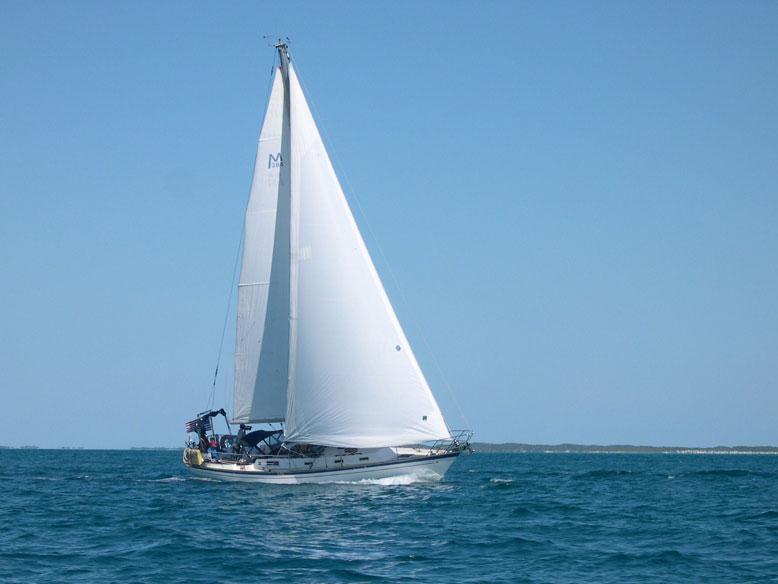
Mary T under sail as seen
by Gormã We departed Nassau on January 28, with Gormã and headed for Allen’s Cay, about 30 miles southeast of Nassau. Our boat was freshly stocked with food and booze and we were eager to see the Exumas. There was plenty of wind, so once we exited the harbor, we killed the motor and sailed all the way to Allen’s Cay. Allen’s is known for its huge iguana population. When you approach the beach in your dinghy the reptiles come charging out of the bush to greet you because they are used to so many people feeding them. Sounded like great video footage, but it wasn’t to be as we never got to the beach. 
A lizard attempting to walk upright The anchorage was jam packed with boats, when we arrived so we had to move toward the outskirts where the current was stronger and the holding less firm. It took three tries before the anchor seemed to hold. Gormã was having a heck of a time finding a spot as well. Finally, we got around to assembling and pumping up the dingy by which time the sun was nearly setting. We got into the dinghy with our glass bottom bucket to have a look at the anchor to see if it had dug into the sand properly. The water is so clear that with the aid of a glass bottom bucket you can easily see individual blades of sea grass twenty feet below. We were dismayed at what we found. The plow anchor was just lying on its side. The blades hadn’t dug into the sand at all. We jumped back onto Mary T and put her in reverse to try and make the anchor set. Then back into the dingy with the glass bottom bucket. We saw this time that one blade had dug in, so we got back on Mary T and gave her more reverse. Another look at the anchor showed us that we still weren’t completely dug in. Unsatisfied with the situation, we decided to set a second anchor of the Danforth variety. We jumped back in the dinghy with the second anchor and dropped it 75 feet in front of the bow about 15 feet from the first anchor. I was having a hell of a time trying to avoid getting the anchor line wrapped up in the dinghy’s propeller, so I had to pass the steering over to Capt. Kenny. We were racing against the setting sun to get the job done, and I was flaking out. 
Gormã under sail as seen by Mary T Back on Mary T, we noticed the bilge pump was working non-stop. “Great, now were sinking,” we thought. A quick look revealed a simple problem. A hose clamp had become disconnected and so sea water was pouring into the bilge but just as quickly being pumped out. Kenny fixed it in a jiffy. Now all we had left to tackle was a problem with the roller furling which we decided to leave until the next day. It was dark. There was no time for iguanas. Kenny sat in the cockpit with a dejected look on his face. “What’s wrong?” “I’m discouraged.” 
Five birds in the hand is worth ___ in the bush? We’d finally arrived in the Exumas, the virtues of which were extolled by so many cruisers, and so far, it wasn’t any fun. We arose at daybreak and got the hell out of that crowded anchorage. Never mind the iguanas. The roller furling problem turned out to be operator error. One of our halyards was preventing us from rolling it up. It was easily remedied by moving the line. Gormã weighed anchor at the same time and headed for Warderick Wells about 26 miles to the south. Even with Corinne’s broken arm, they seemed to be getting underway just fine. 
Bananaquits at the Warderick Wells Park Headquarters We had another lovely sail down the banks across beautiful waters of many hues. Breathtaking. Warderick Wells Cay is home to Exumas Land and Sea Park. There are inexpensive moorings there, so we grabbed one. The view was awesome. Jagged islands poked out of the crystal clear, multicolored waters, and we felt again we were in ad for a fancy travel magazine. 
Corinne and Greg, the crew of Gormã, with Captain Kenny Warderick Wells is part of a national park and is a “no-take” zone, meaning there is no fishing, no shelling, no taking of anything dead or alive from the park. Kenny wondered if one of us died, would we have to leave the body there? There are no public restrooms and no dump so you have to hold on to your rubbish and fill up your holding tank until you leave the park. This keeps anyone from staying too long, ‘cause eventually you need to get rid of your trash, empty your holding tank, and find fresh water. There is no fresh water in the park available for boaters. 
Sign post in Warderick Wells The water was truly pristine and there were many snorkeling sights with multi-colored fish, lobsters, grouper, and eels. It is hoped that the rules that govern the park will allow species to regenerate more quickly and spread beyond the boundaries of the park. One day we went for a nature walk on land with Bill, an environmental scientist, who volunteers at the park. He’s a boater who’s been coming to the Bahamas since the 70’s and the changes he’s witnessed over that short period are tremendous. Used to be you could jump off your boat anywhere and spear plenty of fish and lobster for dinner as well as pick up some conch. It was unusual to share an anchorage with another boat. Now, you have to work pretty hard to find anything. The locals and visitors have fished the waters to near depletion. Even without trying, our anchor chains kill thousands of conch eggs and baby lobsters burrowing in the sand. There wasn’t such a large trash problem back then either. 
Ships mementos left on top of Boo Boo Hill Today, if you walk on the windward side of the islands you find plenty of trash. Even in Warderick Wells, it washes up on the shore from boats or from other islands. Our nature teacher gave us a brief history of the islands – how they were formed, by rain falling through sand creating a layer of limestone, which is the bedrock of all the Bahamas. In the 1400s they were heavily forested with a decent layer of topsoil. In the 1600s the British came and cut down all the trees for the wood, then burned the scrub, imported some slaves and tried to grow sugar cane. They quickly depleted the topsoil and abandoned the Exumas by the late 1700s. It was no longer a profitable piece of the empire. 
We left an intricately inscribed rock that we carried all the way from Cape Sable Island, Nova Scotia, under the memento left by Miss Maddy a couple of weeks earlier Now a fragile layer of soil clings to the top of some of the limestone, though much of Warderick Wells is simply exposed limestone. Jagged and full of holes, it looks very much like a moonscape. I know this from my numerous lunar visits. The primary growth in the Exumas seems to be several varieties of mangroves with their amazing network of roots. More than anything, they keep the soil in place and hold these fragile islands together. Palmettos are also making a comeback. It’s rare to see a tree over 15 feet tall in Warderick Wells. The islands are continually changing shape with the arrival of hurricanes and visitors who stroll on the paths preventing growth. 
The cover photo for our next album On the beach near the Park Office is the skeleton of a massive sperm whale. A placard explains how it washed up dead on the beach full of plastic bags that it apparently mistook for squid. Stupid whale! Anyone can tell a plastic bag from a squid. Bill asked us what we did with our trash. Everyone admitted to holding onto it until finding a trash receptacle of some kind. This of course is useless because the dumps are mostly above ground so a big wind or hurricane blow all the rubbish right back into the water. Bill told us what to do: Far from shore, fill bottles and cans with water and dump over board, so they sink to bottom. Biodegradable food matter can, of course be thrown overboard. Burn paper and plastic. Burn it? Where? I’m still trying to sort that one out. We sink our cans and bottles, but I still take the other stuff to the dump. 
Chillillillin at Exuma Land and Sea Park, Warderick Wells Throughout his lecture, Bill often asked “So what do we do? Not come back? I’m coming back? I don’t know what the answer is.” By the time he finished his talk, we all felt thoroughly guilty and depressed. But rather than get the hell out and leave well enough alone, we fixed another rum cocktail and settled in to enjoy the sunset. 
On the trail for the elusive Hutia On February 4 we departed Exumas Park and headed 15 miles south to Staniel Cay with Gormã. It was Superbowl Sunday and the Yacht Club there, which is not private, was hosting a party with buffet for $20. We didn’t particularly care about the game, but Gormã thought it might be a fun event to attend, so what the hell. A water taxi, a fast outboard motor fishing skiff, picked us up from our boats and brought us ashore. It seemed a rather long trek in a dinghy considering the return trip would be in the dark. As soon as we entered the Yacht Club, which is actually a restaurant/bar, we were overwhelmed with the noise and the crowd. Oh well. It was a seat yourself kind of a situation and we ended up sitting at a table with a couple who stood up when the Star Spangled Banner was sung at the beginning of the game. I know people stand when attending the live event, but a televised one? The woman told Corinne from Gormã (they’re Canadians) to stand up, so she did, and Kenny joined them out of peer pressure. I remained firmly planted in my seat. I have never seen anyone stand in front of a television for the national anthem, and I’ve never understood why it’s sung before sporting events in which the competing teams are both American. I think the entire Congress should have to sing it before state of the union speeches. It seems a more suitable event. The food was pretty good down home style cooking – BBQ ribs, corn, etc. After watching the Tom Petty looks-pretty-good-for-his-age halftime show, we hunted down the water taxi driver and made a quick getaway. The volume level of all the people yelling above the volume of TV sets was just too much for us. The ride back to our boats was terrifying. Our driver skimmed over the waves at a million miles an hour in the pitch black. The only illumination came from the tiny specs of light a top the masts of dozens of anchored boats. I could not understand why anyone would want to drive like a bat out of hell though a crowded anchorage in the dark. I wondered how many people at the Super bowl party forgot to turn on their anchor lights. Suddenly a shadow loomed in front of us. “Boat without light,” I yelled to the driver. He slowed down temporarily, swerved around the boat and sped up again. Kenny and I felt we would surely die before seeing Mary T again. Bahamians are all laid back until they get behind the wheel of a car or power boat. Then they’re all about speed. Fortunately, Kenny had the presence of mind to bring a flashlight and we managed to find Mary T among the horde of darkened hulls. Gormã was close by. 
Pigs on the beach, Big Majors Spot, Exumas Highlights at Staniel Cay included Pig Beach and Thunderball Cave. Pig beach is where a bunch of free-range oinkers hang out waiting for boaters to come by with handouts. With table scraps in hand, we drove the dinghy over to the beach. A skiff with some tourists beat us to the mark. As they approached, three large pigs emerged from the bush and swam out to the skiff. As they dropped the scraps to the pigs in the water, one pig tried to crawl aboard their boat. He had his front hooves on the gunwale and the tourist woman was squealing with delight. She even patted the pig on the head. She apparently hadn’t heard about the tourist who was bitten. We decided to keep a safe distance. Any one of those pigs could easily capsize our dinghy by planting its hooves on the side. Thunderball Cave was a spectacular snorkeling sight. It was featured in a couple of Hollywood flicks—Thunderball and Splash. The fish are not at all frightened and expect to be fed, so they’re all up in your face inside the cave. Once inside the cave opens up into quite a large cavern with sunlight pouring into various holes. Surprisingly, it was not overcrowded with snorkelers. There were just a few others besides Kenny, Greg and I. Poor Corinne had to sit in the dinghy with her broken arm still in a cast. We did bring our glass bottom bucket with us, so she could look down at the surrounding coral heads and fish from the dinghy. Two Pelicans also appeared at Staniel Cay with a new mate on board. Alex left the Admiral in Nassau and returned to Seattle. Anne, whom we met briefly in Nassau, was Jeremy’s latest shipmate from “find-a-crew.” One day when the Admiral was out of earshot, Anne confided to Corinne and I that she and Jeremy were like oil and water. She agreed to stay on with him until George Town, and then she’d be looking for another boat. This also meant the Admiral would have to find another mate. After three days at Staniel Cay, we bid adieu to all of our sailing buddies and headed south for Black Point. We needed to be in George Town before February 12, to prepare for the arrival of our dear friends, Tim and Viki Keating. Gormã remained behind, because Corinne had to fly back to Nassau to have her cast replaced. Greg would wait on the boat for her return. 
An incomplete house--typical of many found throughout the Bahamas Black Point is a little gem of a settlement on Great Guana Cay. “Settlement” is the term for villages on the “family” islands. “Family” islands include all the Bahamian islands outside the bigger more populated ones like New Providence, which is home to Nassau, and Grand Bahama, the island of Freeport. They are called family islands, because they are usually dominated by particular families. In Black Point, the Rolle family seems to be the biggest. The name goes back to a British plantation holder in the 1700s. His slaves took the name and their descendants, got the name as well as the property. Black Point is a cozy little settlement with a strong sense of community where visitors are welcome. Men and women sit on porches and under trees languidly weaving handbags, hats and baskets out of palmetto leaves to be sold to cruise ship passengers at the straw market in Nassau. I don’t know why, but I just felt at home there. We wandered into Lorraine’s Café to use the free internet and enjoy dinner. Lorraine is a young, ambitious entrepreneur who runs the place all by herself. She knew that if she offered free wi-fi she’d get the boating community in for food and drink. We spent one more day in Black Point to do laundry at the nicest Laundromat in the world – clean and breezy with an ocean view. Black Point is one of the few places that offer free water to cruisers. There is a spigot near the dinghy dock where you can fill up your 5-gallon jugs and lug them back to the boat. Boating is all about keeping your stores, water and fuel tanks full and your holding tank empty. We’re always prepared to be at sea for at least two weeks, though we manage to reprovision on a weekly basis. Better safe than sorry. I would’ve liked to stay longer in Black Point to meet some people and volunteer at the school as many other boaters had done. But the Keatings would be arriving in George Town, Great Exuma, soon and we needed to get there a couple of days in advance to prepare for their arrival. We sailed out of Dotham Cut into the deep blue waters of Exuma Sound. The waters on the west side of the islands (the Banks) are shallow and the water varies from emerald green (7-14 feet) to swimming pool blue (16-25 feet). The waters to the east of the Exumas, known as the Sound, are very deep (3000 feet) and dark blue. Here you are exposed to the ocean swells, but are still afforded some protection from the outer islands of Eleuthera and Long Island. En route to George Town, we stopped at Rat Cay, an uninhabited island about 30 nautical miles south of Black Point. We were quite pleased with the anchorage on the west side of the island, because there was only one other boat and we hadn’t yet come across anything so deserted. It didn’t last. Within hours five other boats came and anchored all around us. It was the friendly flotilla of Québécois we’d seen at Staniel Cay and Black Point. Je me souviens. I often eavesdropped on their VHF conversations on channel 72, struggling to understand their Canadian-accented French. We didn’t bother going ashore to explore Rat Cay, because the sun was setting, so we settled into cocktails and dinner preparations. 
Corinne and Amy on the Exuma Sound side of Stocking Island, Exumas We sailed into Elizabeth Harbor, a cruising mecca for hundreds of American and Canadian vessels, on February 9. George Town lies on the south side of the commodious harbor and, on the distant north side, is Stocking Island where hundreds of boats anchor off the beaches, some of them for the entire winter. All kinds of activities take place on the various beaches, but volleyball beach is the most popular, with its daily volleyball games, dominoes, basket weaving, chess, you name it or declare it and it’ll happen. It is indeed summer camp for adults. I encouraged Kenny to lead an exotic dance workshop as an afternoon activity, but he says he still needs to perfect some of his moves. Maybe next year. There is a popular bar on Volleyball Beach called the “Chat and Chill.” They make the strongest rum drinks in the entire Bahamas. Kenny dubbed it the Chew and Spew. There is a George Town Cruisers Net every morning at 8 a.m. on VHF Channel 72. The leaders of the cruising community host a morning program radio beginning with the weather. Lee on Windstar IV usually gives the local weather report based on what she’d learned from earlier reports on her single side band radio. She did an excellent job and it was very helpful, if we failed to get up for the 6:30 a.m. Bahamas weather report given by the famous self-declared Bahamian meteorological expert, Chris Parker. Chris, reporting from Florida, has sailed extensively in the Bahamas and gives a very detailed report designed for people sailing in the area. After giving the forecast, he takes calls from “sponsoring vessels” and responds to specific questions about their sailing itineraries. Most cruisers’ in the Bahamas begin their days with Chris Parker at 6:30 a.m. We sit anxiously with pen in hand, writing down everything Chris says. 
One of many crowded anchorages in Elizabeth Harbour, George Town, Exumas Anyway, after the local weather report on the George Town Cruisers Net, comes “Regatta.” Anyone with announcements about the weeklong regatta in March is invited to relay relevant information. The “Regatta” involves much more than a sailboat race, and includes everything from a masquerade party to a tennis tournament. The masquerade party necessitates a mask-making workshop on the beach and of course there would be practice sailing races in Elizabeth Harbor in advance of the actual regatta….. Following the extensive “regatta” announcements comes “Business.” People looking to sell or buy something, usually a boat part or chart, declare their business. The radio show host reminds everyone that any goods bought or sold in the Bahamas are subject to local taxes. I’m sure all the cruisers dash into the government office to pay taxes on the used boat parts they’re buying from each other. Next on the agenda is “Community.” This is an open forum for anything anyone wants to say, like “Don’t park your dinghy in such or such a place,” or “Anyone want to share a taxi to the airport?” Some cruisers spend their entire winter anchored off of George Town enjoying all the activities, while many pass through after a few days mystified as to how one could spend a whole season at adult summer camp. After one night of anchoring at Sand Dollar Beach, next to Volleyball Beach, we took a slip at Exuma Docking Services Marina to make things easy for our guests when they arrived. It would be difficult in our thimble-sized dinghy to ferry them and their luggage to a distant anchorage. We were unable to hail anyone on the VHF radio at the marina, so we just went in and took a slip. After securing Mary T with a million dock lines, I went in search of the marina office, which was being rebuilt and temporary quarters were set up across the parking lot. The dockmaster was less than enthralled about our arrival, though we would be allowed to stay. It was one of the worst marinas we’ve ever encountered. The bathrooms were filthy and the showers only had hot water! The laundromat had many machines, but most of them were out of order. Many of the water spigots and electrical outlets at the dock were non-functional. Of all the problems there, the one they decided to address was a new office for the lay-about dockmaster. We were only there to pick up our friends, and we’d be off, so it didn’t really matter. We decided to poke around George Town, but as it was Sunday, the only action was inside the churches. In the Bahamas, Sunday is truly a day of rest and no one goes to work. The Peace and Plenty Hotel was open though, so we enjoyed breakfast there and then went back to the pool bar later for a cocktail. For all the talk about George Town and all the cruisers who flock there each winter, we were surprised there wasn’t more going on. A lot of businesses and hotels had folded and it seemed a place in decline. The next day was our most violent ever aboard Mary T. I never guessed that being tied up at a marina could be so turbulent. The position of the marina is not well suited for nor’easters. When the front came through all the boats bounced violently in their slips, pulling hard on their lines. There was so much strain on our docklines that the nylon rope wore grooves in the pilings. It was extremely risky to get off the boat and impossible to be comfortable aboard. Needless to say, we didn’t sleep much that night. Fortunately, the Keatings did not arrive ‘til the following day at which point the wind had let up considerably. Initially, we’d imagined we’d be able to entertain our friends in George Town for awhile, but after enjoying dinner at The Peace and Plenty Hotel, there wasn’t much left to do. We walked around the whole town in 15 minutes and Viki and I took a bike ride beyond the town limits. All that remained was to take a water taxi over to Volleyball Beach and join the other cruisers in their organized frivolity. They were an amiable bunch and were happy to let Tim, Viki and I jump into the volleyball games. Kenny sat on the sidelines looking askance at all the gaming. The beach was abuzz with activities from chess to dominoes to basket weaving. 
At anchor off Rat Cay On February 14 we departed the down-and-out marina and headed north to Rat Cay to anchor for a few days in peaceful surroundings. It would be three days before the next front moved through. Although we were now four on a very small boat, we seemed to fit rather nicely as the Keatings know how to move around the boat in such a way to make things easy. It was nice to have the company of someone other than each other. Their luggage was minimal as were their expectations. This was important, because there wasn’t a hell of a lot to do. We snorkeled, though the reefs in that area were not spectacular. We hiked. We played dominoes. We stared into space. For the cocktail hour, I served up tasteless orange cheese, drywall crackers, and Dark and Stormies. A Dark and Stormy is made with ginger beer, rum, and a wedge of lime. That’s our new favorite beverage. Having the Keatings aboard was great fun. 
Looking for rodents on Rat Cay 
Rat Cay Posted on April 14, 2008Our anchorage at Rat Cay was less than tranquil and I’m afraid one night Viki, who is somewhat prone to seasickness was feeling rather ill. The day we finally weighed anchor was very rough. Had we not had the help of the Keatings, it would have been difficult to bring up the two anchors on our own. They were well dug in and the wind and waves were fighting our efforts to bring them up, but after a 40 minute battle, we finally prevailed. The turbulence of the anchorage was nothing compared to the wind and waves out in Exuma Sound. The eight-foot waves were crashing into us every few seconds and the wind was on the nose. Making headway required employing sails and motor. Fortunately, we were only going about 10 miles south, but it took over three hours. Poor Viki finally succumbed to seasickness and we felt like rotten hosts. She never complained. 
The pool at Emerald Bay The reward was the comfort and luxury of the Marina at Emerald Bay on Great Exuma Island. They offer arriving boaters a welcome mat when docking. This not only serves to buttress the ego, but allows one to wipe the filth of the world from one’s feet each time one goes aboard. The restrooms at Emerald Bay were immaculate, the showers were roomy and included clean towels, complimentary soap, shampoo, shaving cream and lotion. The Laundromat was free! There was a pool table and TV room with big comfy sofas and a library with wi-fi that worked. 
Emerald Bay In addition to all the fabulous amenities, there were two luxury resorts and a lovely crescent shaped beach within spitting distance of the marina. Tim treated us to some lovely meals at the hotels and we took advantage of the swimming pool and hot tub at one resort, even though it was forbidden. At least our guests got a taste of luxury before their departure. The boat seemed empty and quiet when they left. After one more day in luxury land, Kenny and I headed back to George Town en route to Long Island. We anchored for a few nights off of Hamburger Beach and enjoyed a lovely reunion with our friends Greg and Corinne on Gormã. We even celebrated a pirate Friday together. Corinne was in character so deeply, we wondered if she’d ever emerge from her pirateness. “Aaargh, rum punch!” she cried out repeatedly with gusto. We all sang the Bahamian verse of the Pirate Friday song together:
Greg and Corinne were truly our sailing soul mates, and it was a nearly tearful goodbye as we parted for Long Island. They would be staying put for Chris Parker’s meteorological seminar in George Town and then heading north back up the Exuma chain of islands. 
The prettier side of Salt Pond, Long Island We set sail for Long Island on February 23, Kenny’s birthday. To celebrate the momentous occasion, we threw away our cans and bottles in the deep blue water of Exuma Sound. It seemed wrong, but it is the recommended method of disposal according to several sources. We remained on Long Island for 10 days and saw nearly the whole 80-mile-long island. We rented a car for two days and Kenny let me do all the driving, because he was not comfortable driving on the left hand side. The car was insured for liability, but we would be responsible for any damage to the vehicle itself in the event of an accident. Not an ideal situation but there was so little traffic it hardly seemed worth worrying over. The Queen’s Highway, which runs from the north end of Long Island to the south, is dotted with tiny settlements most of which are so small you hardly knew you’d been through one. 
The uglier side of Salt Pond, Long Island Kenny read from the map as we went along. “Coming up on the left is Kimmy’s Fashions and Notions store. On the right, the Methodist church…S & M Variety Store…on the left Albert’s Ice Cream Parlor and Restaurant….“ What distinguished Long Island different from the Exumas were the tall trees and rich vegetation. People were even growing bananas and papayas. In the Exumas it was rare to see a tree over 10 feet tall, giving it the feel of munchkinland. The people on Long Island looked different too. Most seemed to be a light shade of brown, indicating there was quite a bit of mixing of white and black Bahamians. In all our driving most of what we saw was vegetation and occasional glimpses of the sea when the road left the interior and veered to one side or the other. There were some rather spectacular houses being built, and quite of few ex-pats who had purchased land. Most of them were either German or American. 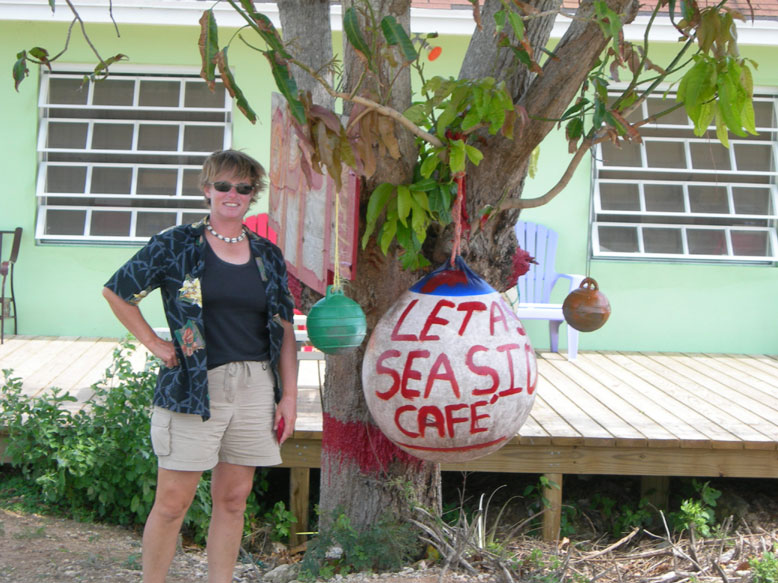
Leta's Seaside Cafe in Deadman's Cay, Long Island
Leta's decor 
Dean's Blue Hole, Long Island, with divers platform in the middle
Dean's Hole drops down several hundred feet from surrounding water and rock One group of Germans has been living on Long Island for three generations and built a resort and marina called Stella Maris. We kept our boat at the marina for five days and ate a couple of meals at their resort. A grave stone marks the spot where the original founder was buried. It reads: Johann Helmuth Aufuchs 1907-1977. We contemplated the pronunciation of his last name and wondered if he’d escaped the horrors of WWII or fled afterwards for nefarious reasons. The most spectacular thing we saw on our drive was Dean’s Blue Hole. Surrounded by high cliffs on one side and sandy beach on the other, the world’s deepest blue hole was something to behold. We hiked up the cliff for a better look and saw the ocean to the east and the emerald green banks on the west side of the island. By late afternoon we had arrived in Clarence Town toward the southern tip of the island. It was the closest thing to a town we’d seen all day. There were restaurants, shops, and two spectacular churches built by Father Jerome the British Anglican architect turned Catholic priest. Still, like much of Long Island there were few people about. I had a hard time enjoying Clarence Town because a toothache, which had been plaguing me for a few days, was becoming more acute and I was starting to worry. We’d stopped earlier in the day at the only private dentist’s office on the island and were told by a lady weaving a basket on a porch nearby that the dentist would be absent for a week because his wife was having a baby. I inquired at the Rowdy Boys restaurant in Clarence Town if there was a dentist anywhere on the island, and was told “no.” I bought an over-the-counter product to ease the pain and drank a beer with Kenny at the Rowdy Boys bar and chatted with Bert Knowles, the owner. He told us his life story about building and racing sailboats, his construction business, agricultural project and finally building the restaurant and attached hotel. I missed all the finer details as he spoke rather softly and his accent was difficult to understand. But I was grateful to at last have a conversation with a Bahamian that lasted more than three minutes. 
Littered beach on Atlantic side of Long Island 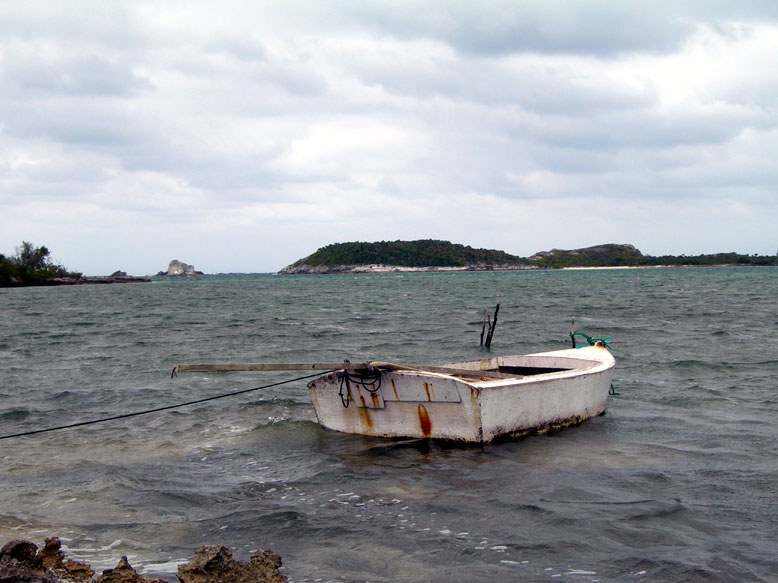
North end of Long Island, near Cape Santa Maria We’d been traveling in the islands for a month and a half but had only superficial contact with the locals. For me, to visit a country without eating a meal in the home of a native means never having been there. I was learning about the Bahamian environment, but I knew nothing of the people – how they lived, what they talked about, or what they thought of Americans. I could tell by the number of churches, they were devoutly Christian, but apart from that I knew little. On our way back to Stella Maris Marina we made a stop at Max’s Conch Bar. The roadside tiki bar was packed. We bellied up and ordered a couple of Kalik’s. I had a “light” because I was the designated driver. The patrons were mostly young local fishermen boasting loudly about their catches and speeds of their vessels. There was a very convivial feeling about the place and I would’ve liked to go back, but it was in the middle of nowhere and we wouldn’t be keeping the car forever. Besides, I didn’t want to be driving for too long in the dark, over potholes, on the wrong side of the road. Rolling stones and sailing ships gather no moss. 
Abandoned UFO on the shore of Thompson Bay, Long Island 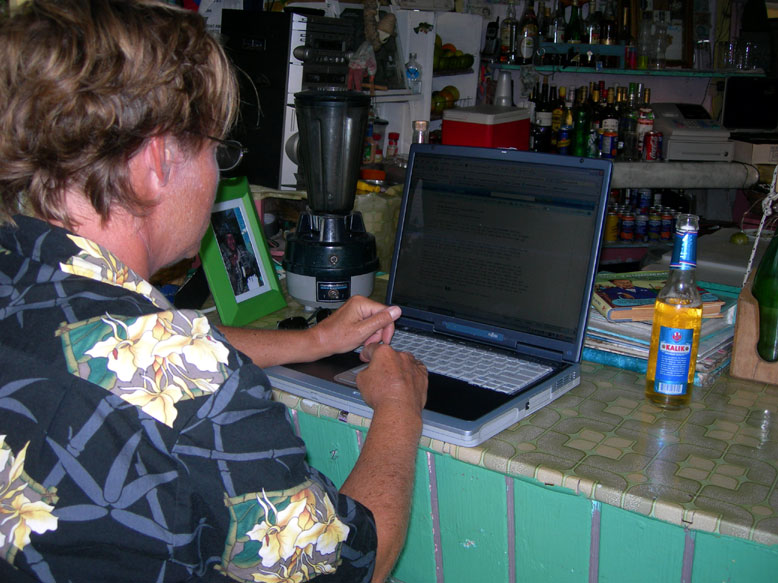
Catching a good WiFi signal at Max's Conch Bar, Deadman's Cay, Long Island Leaving the Stella Maris marina was difficult because of the shallow water. We ran aground several times even though we were right in the middle of the channel and it was high tide. Our last two nights on Long Island, we anchored at a place called Hog Cay. It was an idyllic setting and the first time in the Bahamas, we had found a solitary anchorage. We were sure it wouldn’t last, but it did. Diving in the water to check the anchor, I noticed the bottom was littered with hundreds of sand dollars. I brought up two for Captain Kenny. Our first night at Hog Cay was rather bouncy, but our second one peaceful. My tooth problem seemed to be waning, but I knew I should consult a dentist before the pain became unbearable. We had decided against going to the more remote islands of Conception, Rum Cay and Cat Island, because of the cold fronts that continued to sweep through the islands every week. It would be difficult to find sheltered anchorages in those places, and I surely wouldn’t find a dentist. We elected to return to the Exumas and search out a dentist in George Town. As we approached I put out a general call on the VHF radio inquiring about a dentist in the area. I immediately got several responses. There was indeed a dentist at the government clinic and no appointment was necessary. We anchored near George Town and got the dinghy ready as quickly as possible, so I could make it to the clinic before closing time. 
In search of a dentist on Long Island
A Church in Clearance Town, Long Island 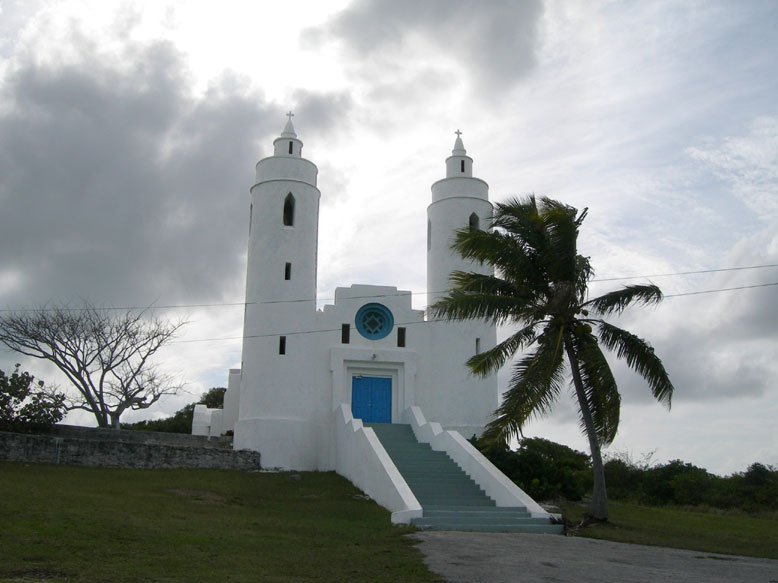
Another Church in Clearance Town, Long Island I raced over to the clinic and was told the Dr. Lee was busy, but that I could see him shortly. I sat outside on a wooden bench with a bunch nurses who told one violent story after the next. One anecdote involved a woman who came to beat up a nurse at the clinic, but they beat her up before she could get to the nurse. Then they talked about how unfortunate it was that educators were no longer allowed to beat students. I was careful not to get on their bad side. After a brief wait, I was issued into Dr. Lee’s office, whom, given the name, I assumed would be Chinese. Turned out he was American or Canadian born. I didn’t ask. He quickly diagnosed my periodontal problem and recommended some antibiotics and cleaning methods using hydrogen peroxide and baking soda. He also threw in a bunch of miniature brushes for cleaning between the teeth. The whole thing cost only $30 and I’ve been fine ever since. Of course I’ll need some periodontal work when I return to the states, but I reckon I can make it for a few months. If we were staying there longer, I would’ve gone back for a cleaning. He was such a sweet man and there were pictures all over his office of Bahamian elementary school students and their letters expressing gratitude for his services and advice. We had anchored near Two Pelicans, so on our way back to Mary T in our dinghy we stopped to say hello to our old travel buddy the Admiral. He generously invited us aboard for some beers and told us some rather intriguing tales. One drunken night he found himself at an out of the way George Town bar in the wee hours of the morning playing a drinking game. The game involved holding a quarter between the cheeks and dropping it into a glass. Butt cheeks or face cheeks? Unfortunately, we failed to inquire. He then told us one girl was topless throughout the game and he imagined her profession was “exotic” dancing and that her boyfriend was a club owner and her employer. Hmmmmm…. Posted on April 26, 2008 from Treasure Cay, in the AbacosDeparting George Town on March 5, we hailed our friends on Gormã on the off chance that they were within VHF range. Much to our surprise they were still in George Town. We promised to meet in the next few days somewhere up the Exuma Chain. Two days later we found ourselves about 40 miles north of George Town at Sampson Cay preparing to wait out another cold front. March 7, 2008, Sampson Cay Everyone is grumpy today. It started with the anchoring dilemma. Is it good here? Should we move a few feet over there? Should we continue north and take a mooring at Cambridge Cay? Should we go into the marina at Sampson Cay? For hours we mulled. Kenny becoming increasingly more anxious, and I more grumpy because I just wanted to go snorkeling or do something fun. The dark mood temporarily lifted when we rode the dinghy ashore and ate lunch at the marina. A couple of other boaters at a nearby table told us the anchorage got mighty rocky in a blow and we might want to consider taking a slip at the marina. That did it. I went and made a reservation for the following day. After lunch, I got to do some snorkeling, but Kenny was still grumpus rumpus, so I fell into my sour mood again too. I felt useless and fat and in my mind blamed Kenny for everything. I was losing interest in shooting the video and keeping up with the travelogue. Maybe none of it mattered, anyway. Ambition is the root of all unhappiness. Why not just sit in the sun, read books and drink rum punch? 
Amy and The Conch Blowers performing at Sampson Cay Marina, Exumas 
Amy introduces the Conch Blowers as the crowd calls for an encore By evening our moods had improved. One can only remain cranky for no reason for so long. After all, we had it pretty good. We spent the next two days taking beach walks and lounging at the marina. The weather did not turn out to be as severe as expected, but we didn’t have to worry about it in the well-protected marina. We made a new friend on a boat called Blessed Spirit. Our first impression, upon hearing the name of his boat on the VHF was that he must be a born-again Christian. Our second impression, as he pulled into the marina single-handing a 47-foot sloop, was that he must be crazy. It turned out he was neither born-again, nor a single-hander. His wife was just temporarily away visiting an ill parent. He became our instant friend and shared most meals with us while we were in the marina. Corning Townsend III is a marine architect and a delightfully funny fellow. As many people do in these parts, he blew his conch every night at sunset. I decided one night to play my saxophone with the conch players at the marina. There were three of them and myself. I quickly realized that most conchs blow a concert “E.” So I chose some tunes that are primarily in “E” and the saxoconch band was born. Girl from Ipanema and blues in E seemed to work best, though I found it difficult to get through a tune without laughing. After the blow, we headed 3 miles south to the anchorage at Big Majors (home of the swimming pigs adjacent to Staniel Cay) to meet up once again with Gormã. They invited us and another couple over for drinks. It was a delight as always. Ahh the laughs, drinks, camaraderie. All was well until I learned that the other couple were in the diplomatic/development field and I asked a question about Haiti. What followed was a two-hour lecture on the history of the country beginning with colonization by the French. It was interesting and all, but all I really wanted to know was if Aristide was a good guy or a bad guy. Turns out he used to be a good guy but fell victim to the old “absolute power” adage. 
Abandoned footwear on at Cambridge Cay, Exumas We met up with Greg and Corinne once more in Cambridge Cay, which is part of the Exuma Land and Sea Park. The snorkeling was fabulous though the current rather strong at many of the sights. A bull shark took up residence underneath Mary T, so we didn’t do much swimming around the boat. We hosted a dinner party our last night there and I served up pasta with a red sauce made with spicy Italian sausages. Gormã would not be joining us on our trip to Eleuthera and the Abacos. They needed to return to Canada to tend to Corinne’s aging mother. It was our third and final good-bye to our dear friends. On March 14 we re-entered the Exuma Sound and headed northwest for Eleuthera. For once the wind was absent and the water flat as a pancake, forcing us to motor all the way to Eleuthera. We took the opportunity to empty our holding tank in the deep waters well offshore. This task is accomplished using our auxiliary manual bilge pump. Kenny pumps the handle back and forth sucking the contents of the holding tank up the hose into the pump and over the side of Mary T. I am very grateful that he has never asked me to undertake this chore. I standby and pass him things like surgical gloves, water and Clorox to rinse the deck and hand sanitizer when he’s finished with the job. Cleanliness first! 
Amy at the Ocean Hole in Rock Sound, Eleuthera 
One of the prettier, restored houses in Rock Sound, Eleuthera Two other boats were headed to Eleuthera the same day and we made their acquaintance over the VHF radio. We all arrived in Rock Sound Harbor in the late afternoon. One boat immediately invited the rest of us over for sundowners, which I thought extremely generous, as we didn’t really know them. Not only did they invite us, but they came to pick us up in their dinghy. Kenny was dragging anchor about going because he needs his down time and we’d had a lot of social engagements recently, but such a kind offer was impossible to pass up. We brought coconut rum and the usual tasteless cheese and drywall crackers as an offering. It is a rule, to never go empty handed to a boaters cocktail party. In no time we were four couples aboard the boat and everything seemed to be happening at top speed. Everyone seemed to be talking at once. I found it all rather delightful and amusing. One man suggested we rent a minivan together the following day and go visit the island. Everyone seemed game, but I knew Kenny was dying inside at the mere thought of it. His social meter had already gone way past red. The more everyone drank, the louder and more loquacious everyone became. After several hints from the hostess, that everyone go eat dinner and soak up the alcohol, we finally took our leave. We would have left sooner but since we didn’t come in our own dinghy, we weren’t sure about the protocol in demanding to be taken back. In the boating community, friends are easily made and a helping hand is never far away. This is a wonderful thing in terms of feeling safe at sea and for socializing when a couple needs to expand. If, however, you need privacy or down time, it can present a challenge. The next day we declined joining the others in sharing a rental car and decided to move up the Eleutheran Coast to South Palmetto Point. This was not the best of decisions. Arriving there we found the anchorage very lumpy due to the southwesterly wind, which was kicking up waves. There were two, free government mooring balls, so we decided to grab one. The chain looked awfully rusty, but for some reason we were not deterred. We put one of our lines through the rusty shackle on top of the ball and settled in. Kenny eventually decided to add a second rope securing us to the mooring. After an hour and a half, we determined the mooring was holding and decided to jump in the dinghy and head for shore, which was only about 100 yards off of our stern. Kenny was already in the dinghy and I was about to untie the dinghy’s painter and hop in, when a woman in a boat that had just anchored nearby, began pointing and shouting in our direction. Mary T was drifting away from the mooring. Kenny screamed for me to start the engine, but the key was locked away and I didn’t have my glasses on and couldn’t read the combination lock. He was back aboard in seconds and liberated the key. We started the engine just as our keel began bouncing along the bottom ever closer to shore. Kenny ran forward and I took the helm and put the engine in reverse hoping to move us into deeper water. Fortunately, it worked. In no time we were off the bottom. Kenny came back to report what had happened. The chain, which attaches the float/ball to a heavy weight on the bottom, had broken and we were drifting along with the ball and chain. Kenny freed us from the ball and dangling chain. At a safe distance from shore, we dropped the anchor. The whole thing happened so quickly we hardly had time to panic. Had we left the boat 10 minutes earlier and gone into town, we would have returned to find Mary T washed ashore, lying on her side. We felt extremely lucky. We worked up the courage to leave Mary T again. Pulling the dinghy up on the we took stock of the scene. Music was blasting from a large homemade beach bar and people were setting up bottles of liquor in preparation for a party. We wondered if it was private or not. I asked some guys on the shore if it was okay to leave our dinghy there and they nodded and smiled. I realized later they were Haitian and may not have understood me. Walking past the party preparations, a man waved us over. We approached the bar and he immediately thrust a shot of tequila in my hand. I thanked him, took a sip and then gave it to Kenny. “No, no,” said the man. I was to drink it all myself. I finished it, gave back the cup, which he refilled and passed to Kenny. Maybe he felt sorry for us after our mishap on the mooring ball or maybe it was just standard hospitality in South Palmetto Point. We wandered off down the only road in search of a restaurant. A car stopped and offered us a ride. We gratefully accepted and learned that we were welcome at the beach party if we wanted to come back later. Our chauffeur, Laura, deposited us at Mate and Jenny’s where we enjoyed a salad and delicious conch pizza followed by a game of pool. Heading back to the beach (a distance of only1/4 mile) we were offered another ride, this time by an American who had purchased property on the beach. Such a friendly place we had not encountered. She told us that was how everyone was in South Palmetto Point. Arriving back at the beach, we could see Mary T’s anchor light bobbing in the darkness and were reassured that she hadn’t drifted. The beach party was picking up and I danced up a storm with the Haitian boys. None of the Bahamians took to the dance floor. Kenny sipped a beer and danced in his head. Finally exhausted, we took our leave. A local fellow helped us drag the dinghy back into the water and held onto in knee-deep water until we got the outboard started. Bouncing through the two-foot chop, we were completely soaked with salt water upon reaching Mary T. The anchorage was too lumpy to sleep soundly so we lay down in the saloon with our clothes on in case the anchor dragged and we needed to jump up. It was indeed a fitful night. In addition to bouncing around, I felt slightly queasy (the conch pizza?) and the rash on my chest was starting to kind of hurt. I became convinced in the wee hours of the morning that it must be shingles. If so, the pain would increase to almost unbearable proportions. Finally the sun came up and we contemplated our options. Another blow would be coming soon and we needed to find a protected anchorage. Despite the lovely hospitality we enjoyed at South Palmetto Point, it was too uncomfortable and exposed to stay anchored there. There was a marina close by, but upon closer inspection by dinghy, Kenny deemed it too shallow and the surroundings uninviting. We decided our best option was to return to Rock Sound, which was well-protected from all sides. I could also find a doctor there at the government clinic, if I decided I needed one. In the end, I realized it was “sea lice” and not shingles. Rock Sound turned out to be a good choice. The harbor was sheltered from all directions and the town was celebrating its annual homecoming. Once a year all the town’s natives return for a weekend of camaraderie, feasting and LOUD music. The main street was lined with booths selling trinkets and food and there was a stage for live music and performances. 
Junkanoo parade at the Rock Sound Homecoming Festival 
Ditto 
Ditto 
Spelunking expedition south of Rock Sound 
Squall approaching the Rock Sound Anchorage One night there were several acts by children. A group of pre-teen girls came up and did a choreographed hip-hop number with lots of erotic moves. Then a group of equally young boys wearing matching camouflage, did a similar routine. I found this interesting in such a highly Christian environment. It reminded me of the display I saw in the rear window of a pickup truck at the gas station in town. In the center of the window was a sticker of the Virgin Mary and in one of the corners a sticker of a mud flap girl. (That’s a sexy nude silhouette of a busty woman in a provocative position, often seen on mud flaps of 18 wheelers). The owner of the truck had no difficulty displaying the saint and the slut in close proximity. Indeed, I thought, in the minds of most men, the two together make up the ideal woman. My favorite act at the Homecoming was the fashion show with girls aged 9-12. As each model flounced across the stage in a colorful, frilly, party frock the announcer gave a brief description of the girl. “Annette is 10 years old. Her favorite color is pink. Her hobbies are reading and playing with friends. She wants to be a teacher.” There was a band that took to the stage a couple of times to play traditional Bahamian music called rake and scrape. It has an upbeat tempo and always features someone scraping the edge of a saw with a piece of metal, which sounds much like a washboard. This particular band also had an electric guitar, bass, and drums. Most of the people dancing seemed to be tourists except for a few old drunk Bahamian men who enjoyed engaging the attractive female tourists. It seems the only thing that gets a lot of Bahamians dancing is junkanoo. The second to last night of the Homecoming a small group performed a junkanoo. It is a traditional Bahamian street procession with drums and brass and people wearing tremendous costumes with elaborate headdresses and huge cardboard pieces with moving parts that extend out from the body like turkey feathers. It’s a wonder they can even move in them. The marching drummers beat out a hypnotic rhythm, while the brass instruments throw in accents and the whole masquerade parade struts/dances down the street. We stayed up late to catch a glimpse of this mysterious junkanoo about which we’d heard and read so much. Nobody is sure exactly how the tradition developed but it’s African roots are evident. Junkanoo is performed on boxing day (December 26) and New Year’s Eve, but they also do mini-junkanoos on special occasions. That night at the Homecoming we ran into the group of Quebecois cruisers with whom we’d endured the terribly rough night at the marina in George Town. One couple, Guy and Lorraine, on 31-foot Kergeulen, ate lunch with us the next day at a local and surprisingly inexpensive restaurant. They are a most delightful, good-humored couple in their mid-fifties also sailing for the first time in the Bahamas. They speak fluent English in addition to French and, as we were to learn, very popular amongst many cruisers. They were thoughtful and interested in trying to decipher the Bahamian culture. So many cruisers talk of nothing but their boats and the various problems they’ve encountered, and what kind of anchors they’re using, and how they just fixed their diesel engine and bought a new part for their blah, blah, blah. Oh, we are all somewhat guilty of excessive boat talk, but it’s nice to meet people who like to chat about something different for a change. One thing we discussed over lunch was whether or not any racism exists between black and white Bahamians. The black population of the Bahamas descended from West African slaves who were brought to work on plantations. The original whites were of three stripes: British; Americans loyal to the crown who fled the colonies after the American Revolution; and the Eleutheran Adventurers, who were Brits from Bermuda seeking religious freedom. Unlike the former two groups who often brought slaves, the Eleutheran Adventurers rejected slavery. Today racism seems nonexistent in the Bahamas, but it’s hard to tell as we’ve only been here a short time and we’ve spent too little time with Bahamians. |
|

